
The most common TPD claims in Australia are for musculoskeletal disorders, diseases, and mental health conditions. Together, these three categories account for over 80% of all Total and Permanent Disability (TPD) claims lodged with Australian insurers.
If you have been diagnosed with a serious illness or injury and can no longer work, you may be entitled to a TPD payout. Understanding what a TPD claim is and which conditions are most commonly claimed can help you assess your eligibility and take the right next steps.
This guide breaks down the most common TPD claims by condition, the latest acceptance rates, declined claim statistics, and how a financial adviser can help you navigate the process.
Key takeaways
- Musculoskeletal disorders account for 31% of all TPD claims in Australia.
- Diseases including cancer and heart disease make up 30% of claims.
- Mental health TPD claims have the highest decline rate at 16.9%.
- The average TPD claim acceptance rate reached 93.6% in 2022.
- Average TPD claim processing time is 7.5 months across all insurers.
- A financial adviser can manage your claim without litigation or legal fees.
What are the most common TPD claims?
You can make a TPD claim if you are injured or ill and permanently unable to work. However, some conditions are claimed far more often than others. The breakdown below shows the most common reasons for TPD claims in Australia, based on industry data.
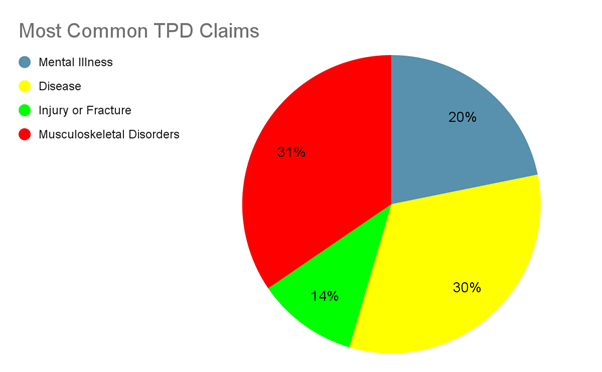
Musculoskeletal disorders lead at 31% of all claims, followed closely by diseases at 30%. Mental health conditions account for 20%, injuries and fractures make up 14%, and the remaining 5% covers other medical conditions. Each category carries different acceptance and decline rates, which can affect your likelihood of a successful claim.
Musculoskeletal disorders (31% of claims)
Back injuries, spinal conditions, chronic pain, and joint disorders are the single largest category of TPD claims. These conditions disproportionately affect workers in physically demanding occupations, such as trades, construction, mining, and manual labour roles where repetitive strain and workplace injuries accumulate over years.
Musculoskeletal disorders include:
- Chronic back and spinal conditions
- Degenerative joint disease and arthritis
- Repetitive strain injuries
- Chronic regional pain syndrome
The decline rate for musculoskeletal claims sits at 16.1%, partly because insurers may dispute whether the disability is truly ‘permanent’ when symptoms can fluctuate.
Diseases (30% of claims)
Serious diseases are the second most common reason for TPD claims. TPD claims for cancer represent a significant portion of this category.
Some examples of diseases commonly linked to TPD claims are:
- Cancer (including terminal and advanced-stage diagnoses)
- Cardiovascular disease and stroke
- Neurological conditions (MS, MND, Parkinson’s)
- Autoimmune and organ-failure conditions
Disease-related claims have the lowest decline rate of all categories at 9.7%.
Mental health conditions (20% of claims)
Mental health conditions are the third most common TPD claim category. Conditions in this category include:
- Severe and treatment-resistant depression
- Post-traumatic stress disorder (PTSD)
- Generalised anxiety disorder
- Bipolar disorder and schizophrenia
Mental health claims carry the highest decline rate at 16.9%. Insurers often find it harder to classify these conditions as ‘total and permanent’, particularly when symptoms may respond to treatment. Having a detailed psychiatric history and strong clinical evidence is critical for these claims.
Check out our complete guides to find out more about TPD claims for depression and TPD claims for PTSD.
Injuries and fractures (14% of claims)
Injuries and fractures account for 14% of TPD claims. These include:
- Traumatic brain injury
- Spinal cord injury and paralysis
- Amputations and loss of limb
- Severe crush injuries and burns
The decline rate for injury and fracture claims is 16.1%, similar to musculoskeletal conditions. Claims involving clear, documented trauma with permanent functional loss tend to have stronger outcomes.
Other conditions (5% of claims)
The remaining 5% of TPD claims cover conditions that fall outside the major categories. These include loss of sight or hearing, severe pregnancy complications, and emerging conditions such as long COVID and chronic fatigue syndrome.
As the nature of work evolves, new claim categories are emerging. If you are unsure whether your condition qualifies, check what TPD insurance covers or speak to a specialist adviser.
TPD claims statistics and acceptance rates
The average TPD claims acceptance rate in Australia reached 93.6% in 2022. This represents a significant improvement from 86.8% in 2021, and continues a positive trend that has seen acceptance rates climb steadily from 86.6% over the five years from 2018 to 2022.
However, the picture varies considerably between insurers. Resolution Life/AMP recorded the highest TPD claims acceptance rate at 93.6%, meaning fewer than 1 in 10 claims were declined. AIA had the lowest acceptance rate at 77.8%. It still approved nearly 8 out of 10 claims approved, but this is significantly lower than some competitors.
Remember that overall approval or refusal rate does not represent whether a superannuation insurer is good or bad.
It is also worth noting the gap between the advised and direct insurance markets. Research from ASIC found that the direct life insurance payout ratio was significantly lower than the advised segment of the market where businesses like Curo operate.
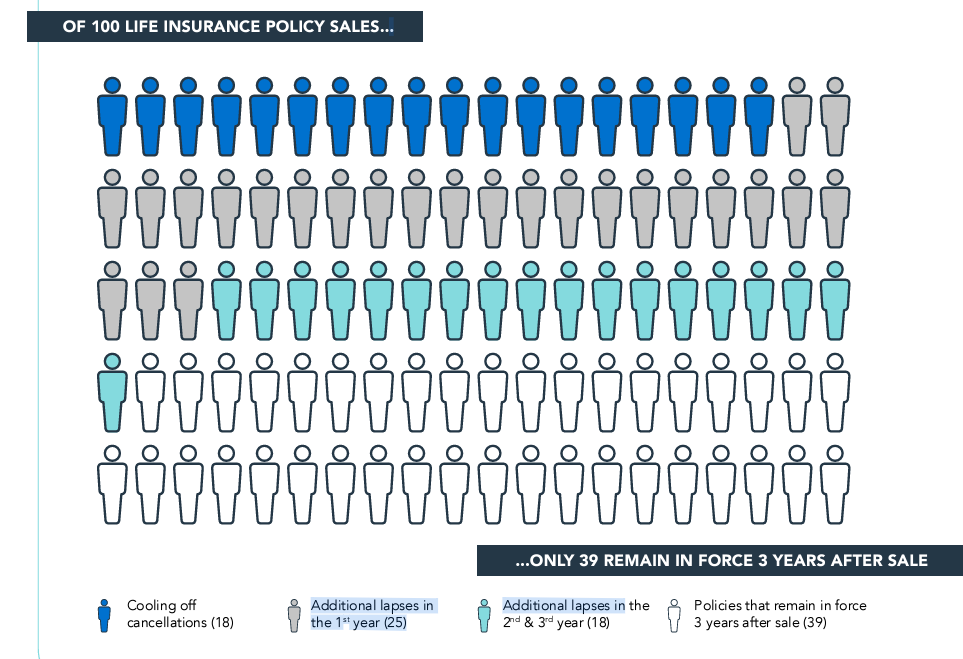
The research cited high cancellation rates and unsuccessful claims in the direct market, suggesting that customers buying insurance without advice are more likely to end up with products that do not meet their needs. Of every 100 direct life insurance policies sold, only 39 remain in force after 3 years.
Source: ASIC Claims Statistics
Data from APRA confirms that the overall percentage of claims paid across all life insurance providers between 2016 and 2021 sat between 92% and 94%. TPD and trauma claims had a smaller share of total payouts compared with life insurance and income protection, but the trend is positive.
Average time for a TPD claim to be accepted
In 2022, the average time for a TPD insurance claim to go through was 7.5 months, and the overall industry average acceptance rate was 93.6%. Resolution Life/AMP had the highest TPD claims acceptance rate of 93.6%. That means fewer than 1 of every 10 claims were not accepted by the insurer.
AIA had the lowest claims acceptance rate of 77.8%, representing nearly 8 out of 10 successful TPD insurance claims from the life insurer. In terms of claim acceptance speed, TAL/Asteron was the fastest, with an average TPD claims acceptance transaction time of 6.2 months, and Zurich/OnePath had the slowest transaction time of 8.8 months.
Understanding how the TPD claims process works can help you prepare for the timeline and gather the right documentation from the outset. Working with a financial adviser who has direct relationships with insurer claims teams can also help streamline the process.
Declined TPD claim rates
While the overall acceptance rate is encouraging, some insurers still decline a significant proportion of claims. Asteron, for example, had a refusal rate of up to 29%. This means that nearly 30 out of every 100 TPD claims were not paid.
TPD claim withdrawals accounted for 81% of all life insurance industry refusals. The major reasons for withdrawal included customers deciding to withdraw their claim, claimants returning to work before the claim was finalised, and failure to respond to insurer information requests.
The medical conditions most likely to be declined are mental health and musculoskeletal conditions, with decline rates of 16.9% and 16.1% respectively. Disease-related claims had a considerably lower decline rate of 9.7%.
Common reasons for TPD claim rejection
Beyond condition type, claims are frequently declined for specific procedural reasons:
- Insufficient medical evidence: Incomplete clinical records or missing specialist reports.
- Definition mismatch: The claimant’s condition does not meet the policy’s specific TPD definition (own occupation, any occupation, or activities of daily living).
- Non-disclosure: Failure to disclose pre-existing conditions when the policy was taken out.
- Late lodgement: Claims submitted outside the policy’s time limits.
- Return to work: Evidence that the claimant has capacity to return to some form of employment.
What to do if your TPD claim is declined
A declined claim does not mean the end of the process. You have several options:
- Request a formal review: Ask the insurer to reconsider their decision with additional evidence
- Lodge a complaint with the insurer’s internal dispute resolution team
- Escalate to AFCA: The Australian Financial Complaints Authority can independently review insurance disputes at no cost to you
- Engage a specialist: A financial adviser experienced in TPD claims management can review your refusal and identify the strongest path forward
Who is eligible to make a TPD claim?
To make a TPD claim, you must hold TPD insurance. You may hold TPD insurance either as a standalone policy or bundled within your superannuation fund. Many Australians have TPD cover through their super without realising it.
Eligibility depends on the TPD definition in your policy. There are 3 common definitions:
- Own occupation: you are unable to work in your own specific occupation ever again. This is the broadest and most favourable definition for claimants, particularly professionals with specialist qualifications.
- Any occupation: You are unable to work in any occupation suited to your education, training, and experience. This is the most common definition in super-linked policies and is harder to satisfy.
- Activities of daily living (ADL): You are unable to perform basic daily activities without assistance, such as bathing, dressing, or eating.
If you hold TPD insurance through your superannuation, your policy likely uses the ‘any occupation’ definition. For many people, this is adequate. But for professionals like surgeons, dentists, engineers, and lawyers, the gap between ‘own occupation’ and ‘any occupation’ can mean the difference between receiving a payout and receiving nothing.
Find out what TPD insurance covers for more detail on how definitions affect your claim.
Do you need a lawyer or financial adviser for a TPD claim?
There are two routes to getting help with a TPD claim:
The legal route: Law firms typically offer no-win-no-fee arrangements and pursue claims through legal channels. This can be appropriate when there is a genuine legal dispute — a contested liability, policy interpretation argument, or the need for formal litigation.
The financial advisory route: Financial advisers manage the claims process directly with insurers, using established relationships and deep knowledge of policy terms. There are no legal fees, no adversarial proceedings, and no court involvement. The adviser works with the insurer’s claims team to present your case in the strongest possible terms.
Curo has processed over $16 million in TPD claims over the last 5 years as a financial advisory firm. Our executive-level relationships with senior claims staff at a number of insurers around Australia help us achieve faster processing and better outcomes for our clients.
For most claimants, the financial advisory route achieves the same result without the cost and stress of legal proceedings.
If your situation does involve a genuine legal dispute, we’ll always let you know.
Frequently asked questions
What percentage of TPD claims are successful in Australia?
The average TPD claims acceptance rate in Australia is 93.6% as of 2022. This is up from 86.8% in 2021, reflecting a positive industry trend. Claims lodged through financial advisers in the advised market consistently achieve higher success rates than those in the direct insurance market, where payout ratios are significantly lower.
What is the most common reason for a TPD claim?
Musculoskeletal disorders are the most common reason for TPD claims, accounting for 31% of all claims in Australia. Diseases (including cancer and cardiovascular conditions) follow at 30%, mental health conditions at 20%, and injuries and fractures at 14%.
How long does a TPD claim take?
The average TPD claim takes 7.5 months to process in Australia. The fastest insurer is TAL/Asteron at 6.2 months, while the slowest is Zurich/OnePath at 8.8 months. Having complete documentation and working with an experienced adviser can help reduce delays. Check out our guide to find out more about how the TPD claims process works.
Can I claim TPD if I have a pre-existing condition?
Yes, you may be able to claim TPD with a pre-existing condition, depending on your policy terms. Your duty of disclosure at the time the policy was taken out is the key factor. If you disclosed your condition and the insurer accepted your application, the condition should be covered.
If you did not disclose your condition, the insurer may deny the claim. Review your policy’s Product Disclosure Statement (PDS) or speak to a financial adviser.
Does a TPD payout affect Centrelink?
A TPD lump sum payout can affect your Centrelink entitlements. The payout is assessed as an asset under the assets test, which may reduce or cancel Age Pension or Disability Support Pension payments depending on the total value.
If the payout is invested and generates income, the income test may also apply. Speak to both your financial adviser and Centrelink before lodging a claim. For more on the financial implications, see our guide on tax on TPD payouts.
Get help with your TPD claim
The TPD claims acceptance rate in Australia is strong, but the process remains complex, and declined claims are more common for certain conditions. Whether you are lodging a new claim, appealing a rejection, or simply trying to understand your entitlements, specialist advice makes a material difference.
Curo Financial Services has processed over $16 million in TPD claims in the last 5 years. We help you navigate the claims process without litigation or legal fees. Our executive-level relationships with Australia’s major insurers help us achieve faster decisions and stronger outcomes.
Start a free TPD claims assessment or call us on 1300 665 356 to speak with a TPD claims specialist. You can also estimate the tax implications of your payout using our TPD taxation calculator.
General Advice Disclaimer
General advice warning: The advice provided is general advice only and in preparing it we did not take into account your investment objectives, financial situation or particular needs. Before making an investment decision on the basis of this advice, you should consider how appropriate the advice is to your particular investment needs, and objectives. You should also consider the relevant Product Disclosure Statement before making any decision relating to a financial product.
Check Your Eligibility for a TPD Claim
Take a short assessment to see if you may qualify for a Total and Permanent Disability claim. It’s quick, private, and helps you decide your next step.
- 2–3 minutes
- No obligation
- Confidential
You'll get guidance based on your answers.
Last Updated on July 2, 2026 by Brent Satill

